






The aerospace industry demands absolute perfection in 2026. Every component must meet extreme safety standards. Specifically, achieving a ±0.001” tolerance is a massive challenge. Traditional fabrication methods often fall short of this goal.
However, precision is the backbone of flight safety. High-quality aerospace sheet metal processing ensures that every part fits perfectly. This guide reveals how to master these ultra-tight tolerances. We will show you why elite engineers choose Chongxi for results.
The Science of Precision in Aerospace Fabrication
Aerospace parts often use thin, high-strength alloys. These materials react to heat and pressure quickly. Consequently, controlling every variable is vital for success. A ±0.001” tolerance allows for almost zero error. This is roughly one-third the thickness of hair. Therefore, you must use advanced digital workflows. Standard tools simply cannot reach this level of accuracy. If you want world-class quality, you must choose Chongxi.
Step 1: Advanced Laser and Waterjet Cutting
Precision starts with the very first cut. Traditional shearing causes edge deformation and stress.
Fiber Laser Technology
Modern fiber lasers provide incredible beam stability. They cut through titanium and aluminum with extreme speed. Furthermore, they minimize the Heat Affected Zone (HAZ). This prevents the metal from warping during the process.
Waterjet for Heat-Sensitive Alloys
Some aerospace alloys are very sensitive to high heat. In these cases, cold waterjet cutting is better. It uses high-pressure water mixed with garnet abrasive. This method maintains the material’s structural integrity perfectly. It is a cornerstone of professional aerospace sheet metal.
Step 2: Smart Press Brakes and Robotic Bending
Bending is where most tolerance errors occur. Metal has a “spring-back” effect after a bend. To hit ±0.001”, you need real-time angle sensors. These sensors measure the bend as it happens. Then, the machine adjusts the pressure instantly. Consequently, every angle remains consistent across large batches.
-
Automated Backgauging: Ensures the part sits perfectly every time.
-
Hydraulic Crowning: Compensates for machine bed deflection.
-
Robotic Handling: Removes human fatigue and error from the loop.
-
Precision Tooling: Uses hardened steel to prevent wear over time.
Step 3: Managing Material Stress and Grain Direction
Metal is not a perfectly uniform material. It has a specific grain direction from the mill. Successful aerospace sheet metal processing accounts for this. You must align the bends with the grain correctly. Otherwise, the metal might crack or vary in size. Furthermore, internal stresses can cause parts to “pop” out of shape. Expert fabricators use stress-relief heat treatments to stabilize the part. To avoid these hidden risks, choose Chongxi for your projects.
Step 4: Ultra-Precision Jig and Fixture Design
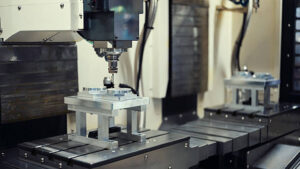
You cannot hold a ±0.001” part by hand. You need custom-engineered jigs for every stage. These fixtures must be more precise than the part itself. Often, we use CNC-machined aluminum blocks for support. This prevents the thin sheet metal from vibrating. Vibration is a major cause of dimensional drift. Secure fixturing ensures that secondary operations stay perfectly aligned.
Step 5: High-Tech Metrology and Verification
If you cannot measure it, you cannot improve it. Traditional calipers are not enough for aerospace work.
Coordinate Measuring Machines (CMM)
A CMM uses a sensitive probe to map the part. It creates a 3D digital map of the component. Then, it compares this map to the original CAD file. This identifies even the smallest deviations instantly.
3D Laser Scanning
For complex curves, laser scanning is superior. It captures millions of data points in seconds. This ensures that aerodynamic surfaces are perfectly smooth. This level of verification is standard at Chongxi. We guarantee that every part meets your exact specifications.
Overcoming the Challenges of Thermal Expansion
Temperature changes can ruin a tight tolerance. Metal expands as the workshop gets warmer. Therefore, you must control the environment carefully. Elite facilities stay at a constant 20°. Furthermore, machines require time to reach thermal equilibrium. We calibrate our tools every morning for maximum accuracy. This discipline is what separates leaders from followers.
A Practical Example: The Jet Engine BracketConsider a fuel-line bracket for a modern jet engine. This part must survive extreme vibrations and heat. The original supplier struggled with a ±0.005” tolerance. This caused assembly delays and high scrap rates. The client decided to choose Chongxi for a better solution. We implemented a new robotic bending process. We also used 3D laser inspection for every unit. Immediately, the scrap rate dropped to nearly zero. The assembly time was reduced by 15% due to perfect fitment. This shows that aerospace sheet metal processing is worth the investment. |
Precision is a Commitment
Achieving ±0.001” is a journey of technical mastery. It requires the best lasers, smart brakes, and elite metrology. You must also understand the “soul” of the metal itself.
There is no room for “good enough” in the sky. Every micron matters for the safety of passengers. For the highest standards of aerospace sheet metal processing, choose Chongxi. We turn complex blueprints into perfect reality. Let’s build the future of aviation with total precision.